


Q3 2026 Recap: Narrow Markets, Higher Rates & Sticky Inflation
Western Alternative Strategies — Quarterly Market Commentary
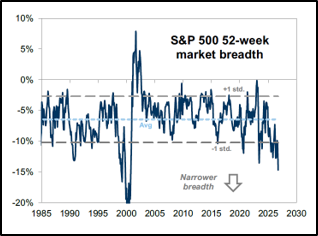
Although the S&P 500 finished within 2% of its all-time high, the median stock remained 17% below its peak.
Dallas, Texas · October 2026

The following commentary presents our assessment of global economic conditions, financial market dynamics, and the positioning implications for your portfolio as of Q3 2026. We encourage you to read this commentary in full and reach out with any questions.
1. Performance Summary
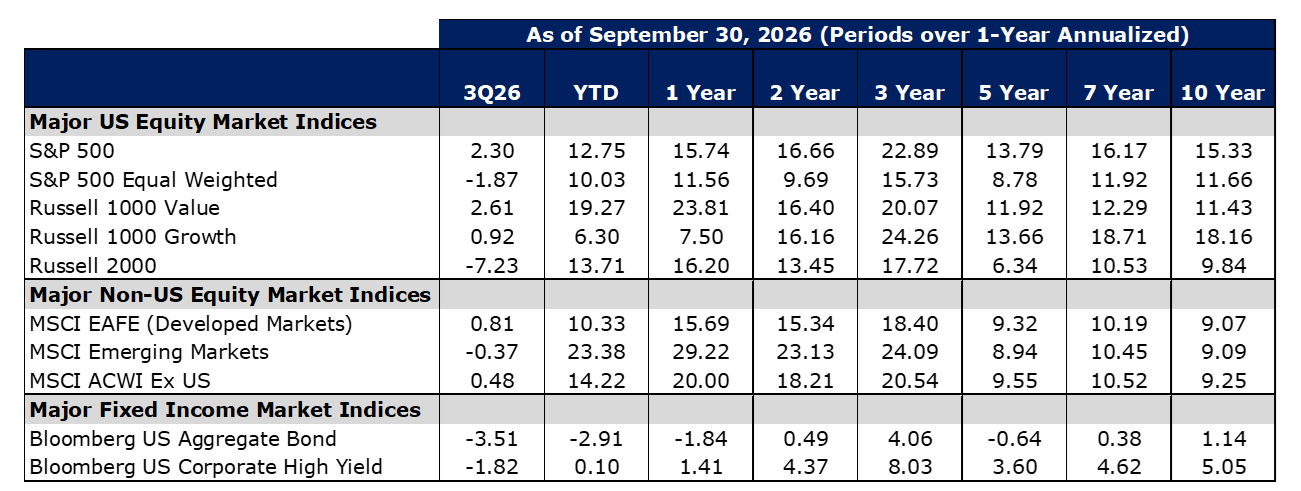
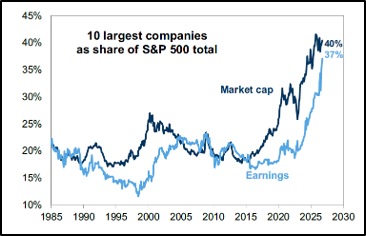
The third quarter marked a rotation back to the concentrated market leadership that has defined much of this cycle. Market leadership became increasingly concentrated in mega-cap Tech/AI themed stocks as higher interest rates, oil prices, and inflation concerns pressured more rate-sensitive areas of the market – including Small Caps. Investors gravitated towards companies with “perceived” high earnings growth that could provide insulation from macroeconomic pressures. Market concentration remained a key market risk but provided valuation opportunities elsewhere when the market broadens.
Rising concentration resulted in deteriorating market breadth and was masked by overall index strength. Although the S&P 500 finished within 2% of its all-time high, the median stock remained 17% below its peak and only 25% of stocks in the index traded above their 50-day moving average. The S&P 500 Cap-weighted Index surpassed its Equal-weighted counterpart during the quarter.
Traditional fixed income also struggled. Rising rates pushed YTD returns into negative territory.
Index Level
2%
How far the S&P 500 finished the quarter below its all-time high.
Median Stock
17%
How far the median index constituent remained below its own peak.
Participation
25%
Share of index constituents trading above their 50-day moving average.
Source: FactSet. Index performance is shown for illustrative purposes only. Indices are unmanaged and cannot be invested in directly.
Source: Goldman Sachs Global Investment Research. Compustat. IBES, FactSet. Goldman Sachs report as of October 2, 2026.
2. Inflation, Interest Rates & Economy
The slow but steady progress on inflation has stalled. Core PCE, the Fed’s preferred measure of inflation, remained stuck around 3% while headline PCE – which includes volatile food and energy prices – materially increased from ~2.5% in mid-2025 to ~3.5% today. Both of these figures are higher than the Fed’s 2% inflation target.
Inflation is largely being driven by things out of the Fed’s control, putting them in a tough position. Current inflation is primarily driven by an oil supply shock and AI-related investment, both of which are relatively insensitive to higher interest rates. This puts the Fed in a difficult position – further tightening could pressure the broader economy without directly addressing the underlying inflation drivers, yet another rate hike may be needed to reinforce its inflation-fighting credibility. Concerns over inflation led the Fed to hike rates in September with market pricing in another hike prior to year-end.
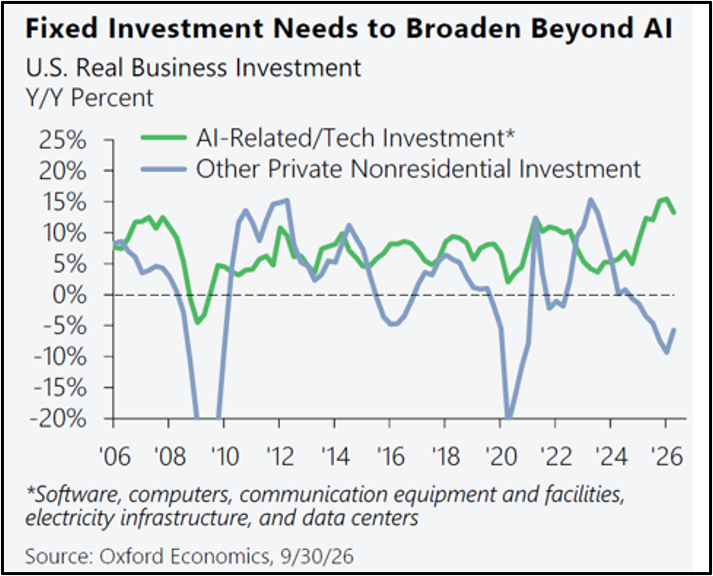
The AI investment boom masks an otherwise mixed economic backdrop. U.S. economic growth and resilience have become increasingly dependent on AI investment and the associated wealth effect of higher-end households. Beneath strong headline growth, labor markets are moderating, non-AI investment remains rate-sensitive, savings are declining, and fiscal stimulus has largely been exhausted. The key risk is whether AI-driven productivity, broader capital investment, and consumer spending can take over as AI infrastructure spending inevitably decelerates.
The rise in interest rates is also an international story. In addition to the US, global yields across many developed countries have reached historically high levels. The synchronized upward move reflected inflation concerns (oil supply shock), hawkish central banks, fiscal debt concerns, and geopolitical volatility. France was the period’s posterchild as its sovereign risk heightened over an unfavorable fiscal position versus Euro-area peers.
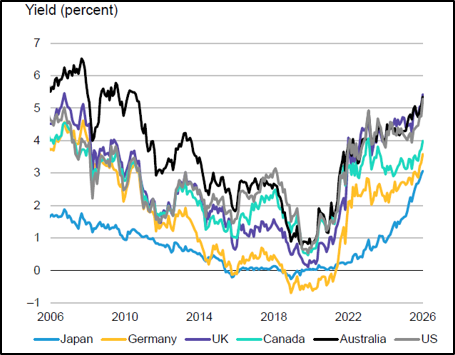
The rise in interest rates is not just an inflation story. It is a misconception that inflation has been the primary source of higher rates. Real rates were also a major cause reflecting strong/resilient economic growth and AI capital investment. Furthermore, the term premium also increased due to investor uncertainty related to factors such as fiscal deficit, rate volatility, and future Fed policy.
The rise in interest rates has yet to materially impact outlook. Credit spreads remain tight and equities are at an all-time high. But history suggests that the combination of rising rates, deteriorating credit conditions, and disappointing corporate earnings could be the catalyst for the next market downturn.
3. Earnings & Valuations
Earnings at the index level remain historically high. Q3 earnings growth rate estimates (year-over-year) for the S&P 500 are 29.5% (at the time of writing). If this growth is reality, it will mark the third-straight quarter of earnings above 25%. Earnings have been the primary driver of equity returns while valuation multiples on an attribution basis have detracted. Sustainability, durability, and broadening of earnings will be key for equity returns going forward.
The concentration of earnings is an important caveat. Strong headline earnings growth masks increasing concentration in AI-related technology and energy companies. This leaves the broader market more dependent on a narrow set of earnings drivers and increases downside risk if AI investment moderates, energy prices normalize, or results fall short of elevated expectations.
Valuations remain high but are improving due to rising interest rates and skepticism around sustainability of AI related earnings. Valuations above long-term averages, but multiples have declined as S&P’s earnings have been increasing faster than its price. Also, investors are less willing to pay a higher multiple for earnings in a higher rate environment, especially for longer-duration assets such as growth stocks.
Portfolio Implications & Positioning
Fixed Income
We remain focused on relative value and quality amid elevated rate volatility, maintaining an overweight to securitized sectors where spreads are generally more attractive than comparable corporate credit. Agency MBS offer attractive spreads and liquidity with government or GSE guarantees, while historically tight investment-grade and high-yield spreads provide limited incremental compensation over Treasuries. We therefore remain underweight corporate credit but are positioned to opportunistically add high-yield exposure should spreads widen materially.
Historically for fixed income, starting yields are generally considered one of the best single predictors of forward returns. After a significant repricing in rates, starting yields today are much higher compared to recent periods, making rates relatively attractive in our view.
Equities
We continue to emphasize valuation, quality, sustainable growth, and global diversification as U.S. earnings become increasingly concentrated in mega-cap AI and energy companies. Our exposure to Non-US Developed and Emerging Markets expand the opportunity set beyond U.S. mega-cap technology, providing access to attractive valuations, differentiated market exposures, and global industry leaders (including those in Technology and AI).
Diversifiers
Diversifying strategies remain an important component of a well-balanced portfolio by providing sources of return that are less dependent on the direction of traditional equity and bond markets. With elevated inflation and interest-rate uncertainty challenging fixed income and rich equity valuations increasing downside risk, strategies such as non-directional credit, opportunistic commodities, and style premia can broaden the portfolio’s return drivers and improve resilience across different market environments.
Tail Risk Hedging for Equities
Tail risk hedging strategy can be an attractive complement to equity portfolios. Tail risk hedging is similar to insurance – it is not about predicting a market crash but insuring against an asymmetric downside event. Top of mind for many investors are potential unfavorable outcomes related to market concentration, extended valuations, sustainability of the current equity bull-market, uncertain fiscal policies, and heightened geopolitical risks.
Explore Further




To discuss how Western builds all-weather strategies for advisors and qualified investors, we’d welcome the conversation.
Appendix & Disclosures
This material is intended for informational purposes only, and does not constitute investment advice, a recommendation or an offer or solicitation to purchase or sell any securities to any person. This material may contain estimates and forward-looking statements, which may include forecasts and do not represent a guarantee of future performance. This information is not intended to be complete or exhaustive and no representations or warranties, either express or implied, are made regarding the accuracy or completeness of the information contained herein. Certain economic and market information contained herein has been obtained from published sources prepared by other parties, which in certain cases may not have been updated through the date of the distribution of this document. Except where otherwise indicated, the information contained in this presentation is based on matters as they exist as of the date of preparation of such material and not as of the date of distribution of any future date. The opinions expressed are subject to change without notice. Reliance upon information in this material is at the sole discretion of the reader. Investing involves risks. Past performance is no indication of future results.
Hedging and alternative strategies involve significant risks, including ongoing costs, potential losses during extended periods of market stability, and the possibility that protection may not be effective in all market conditions. There is no guarantee that any strategy will achieve its objectives, prevent losses, or result in higher returns. Index performance is shown for illustrative purposes only; indices are unmanaged and cannot be invested in directly. This document may be shared with the general public under Rule 506(c). Any offer to invest is made exclusively through the fund’s private placement memorandum or other authorized offering documents and is available only to verified accredited investors. An investment in a Fund is speculative and involves a high degree of risk. All investments involve risk including the loss of principal. Past performance is no guarantee of future results. Western Alternative Strategies is a division of True North Advisors, LLC, a registered investment adviser. As of October 2026.