


Investing in Humanoid Robotics and Automation: Why the Megatrend Is Real but the Valuations Often Aren’t
Western Alternative Strategies — CIO Perspective
Humanoid robots are no longer science fiction. But there is a wide gap between believing in a megatrend and paying a sensible price to participate in it.
Dallas, Texas · September 2026

In a recent feature with Business Insider, Dhruv Maniktala, Western’s Chief Investment Officer, shared his perspective on the robotics and automation investment landscape. His view cut through the ETF noise to a more important point: the most compelling opportunities in this megatrend are in private markets, not public ones.
“The most opportunities for investors are in the private market. Even if early-stage companies don’t end up with scale or profitability, they could be acquired by larger players for their IP.”
— Dhruv Maniktala, CFA®, CIO, Western
The Megatrend Is Real — and Bigger Than Most Realize
The numbers around humanoid robotics and industrial automation are staggering. Barclays predicts a potential $200 billion humanoid market by 2035. Morgan Stanley analysts project the United States could have 8 million working humanoid robots by 2040, rising to 63 million by 2050, potentially affecting 75% of occupations and roughly $3 trillion in annual payroll. But humanoid robots are only one dimension of a much broader automation wave spanning warehousing, logistics, material handling, and industrial operations.
Public markets have responded. Thematic humanoid robotics ETFs have delivered strong returns since launching in 2025, and capital continues to flow toward anything with a physical-AI label attached. The theme is not in question. What is in question is what investors are paying for it.
“Component makers are probably the best way to invest in this theme. Most suppliers will benefit regardless of outcome.”
— Dhruv Maniktala, CFA®, CIO, Western
That insight — favor the picks-and-shovels over the headline names — is where Western’s thinking begins. But we would extend it one step further: the enablers of this megatrend can often be acquired at valuations that bear no resemblance to the ones attached to the robotics narrative itself. That is the principle behind how our Global Private Strategies (GPS) platform approaches opportunities like this one.
The Valuation Gap Is the Opportunity
Physical AI and humanoid robotics names trade at valuations that require near-perfect execution over long horizons. Investors are underwriting outcomes that may or may not materialize, at prices that leave little room for error. This is the definition of a lofty-assumption investment: the business must grow into the multiple, and the multiple already assumes it will.
There is another way to participate. Rather than paying a premium for the promise of automation, investors can own profitable, cash-generating businesses that serve the automation buildout today — and acquire them at conventional buyout multiples.
This is where Western has focused. Our automation exposure comes through a controlled buyout co-investment acquired at a single-digit EBITDA multiple — an order of magnitude below where physical AI and humanoid robotics valuations sit. The distinction matters enormously to the risk profile. A business bought at a single-digit multiple does not need heroic growth assumptions to deliver a solid return. It needs to keep doing what it already does.
ELITE Automation: A Buyout, Not a Bet
One of Western’s co-investments, held in our GPS Series, is ELITE Automation — a business that exemplifies this approach precisely.
Western Co-Investment
ELITE Automation — Automation Solutions Platform
ELITE Automation is a technology-agnostic automation solutions platform that enables customers across critical industrial and logistics sectors to adopt robotics, warehouse automation, and material-handling technologies. Rather than betting on a single robot manufacturer or technology provider, ELITE Automation helps customers deploy complete automation ecosystems across warehousing, material handling, intralogistics, storage, and packaging operations. Its offerings span automation, robotics, ASRS, conveyors, racking, and service — positioning it to benefit from automation adoption regardless of which OEM or robot platform wins. As automation systems become more sophisticated, customers increasingly value partners that can integrate multiple technologies and support them over the full project lifecycle. ELITE Automation’s service-centric model positions it to capture recurring opportunities as automation adoption expands.
ELITE Automation is not a venture-stage company chasing a technology breakthrough. It is an established, service-centric business with real customers, real revenue, and recurring work — acquired at a valuation that reflects what the business earns today rather than what a category might become in a decade.
That is the practical expression of the picks-and-shovels thesis. ELITE Automation benefits as automation adoption expands, regardless of which manufacturer or platform ultimately wins. And because the entry multiple is conventional rather than aspirational, the return does not depend on the most optimistic version of the automation forecast coming true.
Risk, Reframed
Investors are frequently offered a binary choice on themes like this one: buy the theme at whatever price the market demands, or sit it out entirely. We think there is a third option, and it is the one private markets may be uniquely suited to deliver.
|
Thematic Public Exposure Broad access to the automation narrative — at valuations that already price in years of successful execution. Little margin for error. |
Buyout Co-Investment Ownership of a profitable, cash-generating business serving the same megatrend — acquired at a single-digit EBITDA multiple. |
|
Growth Required to Succeed Public physical-AI valuations require sustained, high growth to justify the multiple paid. The business must grow into its price. |
Growth Required to Succeed A single-digit entry multiple means the investment can deliver without lofty assumptions. Growth is upside, not a prerequisite. |
How Western Accesses Opportunities Like This
Western has managed the Global Private Strategies (GPS) strategy since 2019. Across that time, we have made more than 60 primary fund, direct, and co-investments spanning a wide mix of private market sectors — and we are now investing out of our eighth fund in the series.
Each GPS vintage is a “best ideas” private market fund built across venture capital, private equity, real estate, private credit, energy and infrastructure, and other uncorrelated strategies. The chart below shows how asset class exposure has been allocated across each vintage since inception.
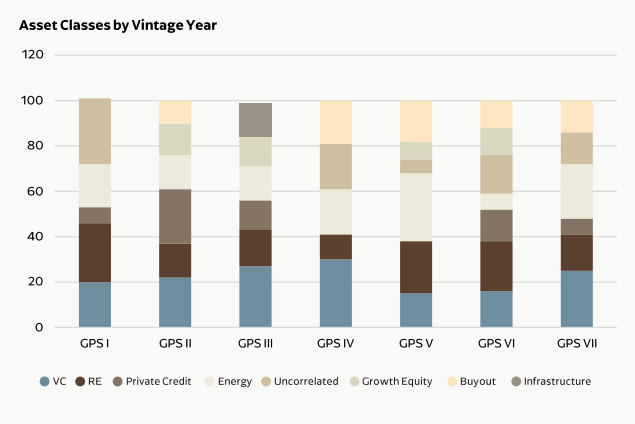
That diversification is deliberate, and so is the focus on smaller, specialist managers operating in inefficient, less-crowded segments of the private markets. Smaller funds have historically outperformed larger peers across asset classes, with wider dispersion that rewards disciplined manager selection.1 And through an open-architecture approach spanning primary funds, direct investments, and co-investments, GPS is able to access opportunities — like ELITE Automation — that sit well outside the crowded end of the market.
2019
Managing the GPS strategy since
60+
Fund, direct, and co-investments since inception
VIII
Current fund in the GPS series
Public Markets Cover Less of the Economy Every Year
The automation megatrend is one vivid example of a broader structural shift: more value creation now happens off-exchange. The number of U.S. publicly listed companies has fallen by roughly half since its 1996 peak — from more than 8,000 to roughly 4,000 today — even as the U.S. economy has grown substantially over the same period.2 Individual investors who limit themselves to public markets are, by definition, accessing a shrinking share of the most dynamic parts of the economy — and paying public-market prices for the parts they can reach.
GPS was built to change that — giving investors access to the kind of private market diversification that pensions and endowments have relied on for decades, packaged into a single vehicle with lower minimums, one subscription, and consolidated reporting.
To read Dhruv’s full perspective on humanoid robotics and automation investing, read the Business Insider feature. To learn more about Global Private Strategies and how Western accesses private market opportunities like ELITE Automation, reach out to your advisor or contact us directly.
Sources
1 MSCI Private Capital. Data as of 9/30/2024. Small-Cap is defined as fund size less than $1 billion; Mid-Cap as $1–5 billion; Large/Mega-Cap as greater than $5 billion. Past performance is not indicative of future returns.
2 World Bank, World Development Indicators (listed domestic companies, United States). Figures exclude investment funds and trusts.
Disclosures
Business Insider is an independent third-party publication. Western did not pay for this feature. Quotes attributed to Dhruv Maniktala are sourced from Business Insider, July 2026. ELITE Automation is referenced as an existing Western co-investment for illustrative purposes only and does not constitute a recommendation to invest. References to valuation multiples are approximate, reflect the terms at the time of investment, and are not indicative of future valuations, performance, or the terms of any other investment. Asset class allocations shown by vintage year are historical and are not indicative of the allocation of any current or future fund. Third-party projections (Barclays, Morgan Stanley) are cited for context and do not represent Western’s own forecasts or guarantees. This document is for informational purposes only and may be shared with the general public under Rule 506(c). Any offer to invest is made exclusively through the fund’s private placement memorandum or other authorized offering documents and is available only to verified accredited investors. An investment in a Fund is speculative and involves a high degree of risk. A Fund is not intended to be a complete investment program. Past performance is no guarantee of future results. All investments involve risk including the loss of principal. Western Alternative Strategies is a division of True North Advisors, LLC, a registered investment adviser. As of Q2 2026.